- Country: UK
- Poems: Almanac of Lunar Songs, Ten Reflections on the Same Pond, Terms of Service: Your Fruiting Body
-
-
Links:
-

-
-
-
Caleb Parkin
Bio
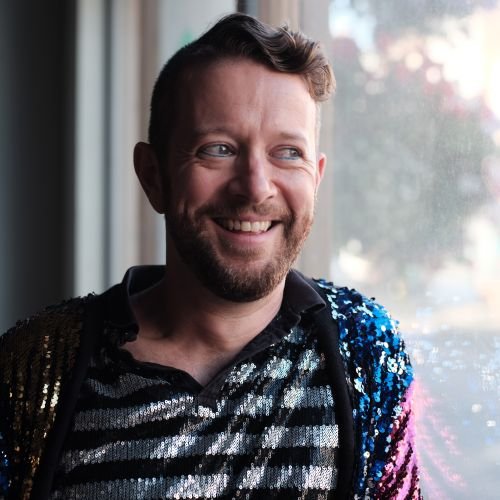
Caleb Parkin has published poems in The Guardian, The Rialto, The Poetry Review and was guest poet on BBC Radio 4’s Poetry Please. He won second prize in the National Poetry Competition 2016, first in the Winchester Poetry Prize 2017 and various other shortlists. His debut collection, This Fruiting Body, is published by Nine Arches Press and was longlisted for the Laurel Prize 2022. He’s published three pamphlets: ‘Wasted Rainbow’ with tall-lighthouse; ‘All the Cancelled Parties’, his collected City Poet commissions; and ‘The Coin’ out in October 2022 with Broken Sleep Books. He tutors for Poetry Society, Poetry School, Cheltenham Festivals, First Story, Arvon, and holds an MSc in Creative Writing for Therapeutic Purposes (CWTP). From 2023, he’s a practice-as-research PhD candidate at University of Exeter, as part of RENEW Biodiversity.
What are the ecological / social crises within your region / country?
Philosopher Timothy Morton articulates ‘hyperobjects’ such as climate change or biodiversity/biodiversity loss, as phenomena with sufficient thingness that we recognise their existence – but which are also distributed massively over time and space. To become aware of these hyperobjects, and realise we live within them, can bring about a state of uncanniness. We experience a paradox of their micro (small-scale) and macro (largescale) effects. The rain becomes less real than climate change, for example. The sighting of a jay, less real than the biodiversity loss it comes to represent. Morton writes in his essay ‘Poisoned ground: Art in the Time of Hyperobjects’ that artworks should reflect this, in form as much as content or subject matter. In terms of environmental ethics, I think we need to engage our imaginative capacities to help perceive environmental harms generated in one place but felt in another, far off, location. For example, here in Bristol the exhaust emissions of the M32 motorway – which I can hear right now, as I dictate these words – settle in the area immediately around it, beneath the flyover. This leads to lower price housing, inhabited by less privileged people, often more likely to be from a BAME background (because of the persistent structural inequality between privilege and race). Those passing through in their vehicles (including, at times, me) leave toxic aftereffects in their wake, often motoring off somewhere far away from those consequences. On a global level, this 'slow violence' is what Rob Nixon describes in his book of the same name. This extends beyond human consequences, into massively distributed temporospatial (time/space) violences to the entire biosphere. I think poetry – with its scalar shifts and ability to hold multiple perspectives and ambiguities – is uniquely placed to support this in the public imagination. As part, I hope, of a cultural tipping point – one which makes conversations about climate change and environmental degradation many, various, and unavoidable. What kind of a poetics might articulate all this uncanniness, each of our complex culpability, in this slow violence? References: Morton, Timothy. ‘Poisoned Ground’. Symplokē, vol. 21, no. 1–2, 2013, pp. 37–50. Nixon, Rob. Slow Violence and the Environmentalism of the Poor. Harvard University Press, 2011